
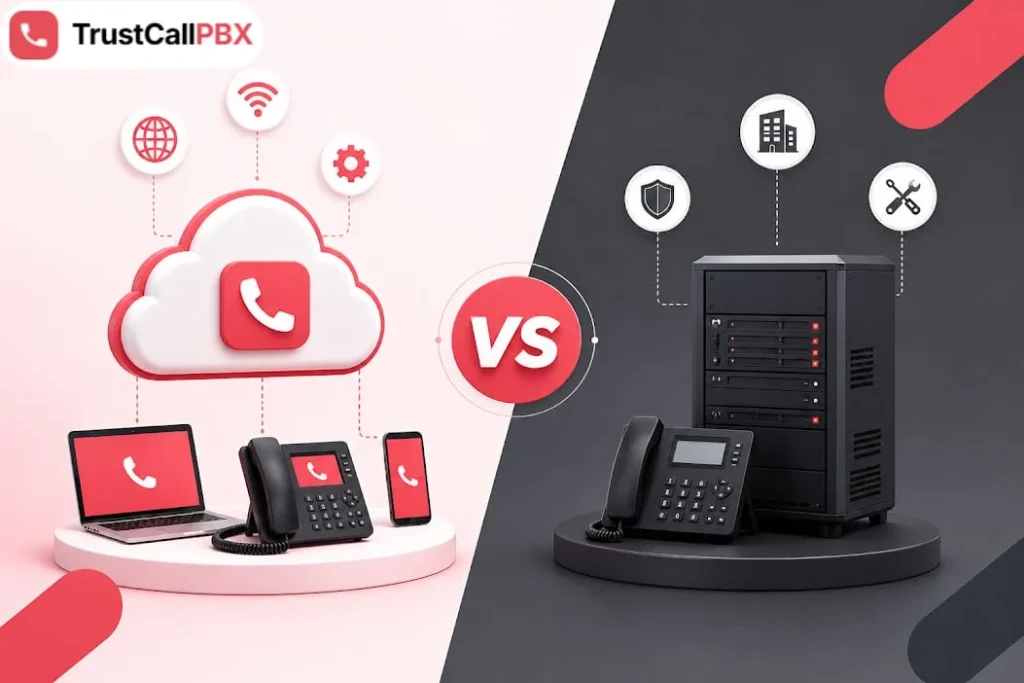
If you’re running a small or medium business in 2026 and you’re still relying on a traditional landline-based phone system, you’re probably feeling the strain in ways that go beyond just the monthly bill. Maybe it’s the cost of adding a new line when you hire someone. Maybe it’s the fact that nobody can take a work call from home. Or maybe it’s simply that your phone system feels like a relic from a different decade because, in many ways, it is.
This is where the comparison between hosted PBX and traditional PBX becomes important. Understanding the real differences not just the marketing buzzwords can help you make a decision that affects your business communication for years to come.
What Is a Traditional PBX?
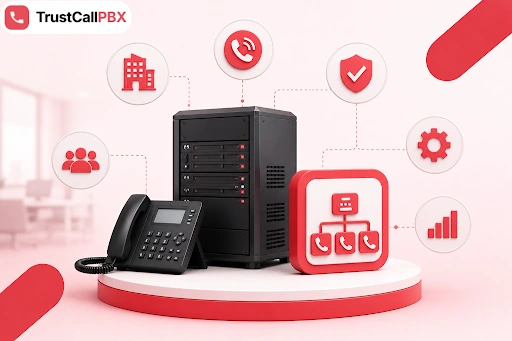
A traditional PBX (Private Branch Exchange) is a physical telephone switching system installed on your business premises. It’s the hardware box, often tucked away in a server room or under a desk, that connects your internal extensions to the outside phone network through physical phone lines.
If you’ve ever worked in an office with a wall-mounted phone system, multiple desk phones with extension numbers, and a dedicated IT person (or vendor) who comes in to “configure the PBX” when something changes that’s traditional PBX.
How Traditional PBX Works
- Physical hardware sits on-site, requiring space, power, and often a dedicated cooling environment
- Phone lines (analog, ISDN, or PRI) connect this hardware to the public telephone network
- Desk phones are wired to the PBX system, each assigned an extension
- Adding new extensions, lines, or features typically requires a technician visit
- Maintenance, upgrades, and troubleshooting depend on whoever installed the system
The Real Costs of Traditional PBX
The upfront cost of traditional PBX hardware can run into thousands of dollars depending on the size of the system, and that’s before accounting for installation, wiring, and ongoing maintenance contracts. Then there’s the cost of physical phone lines themselves, which in many countries are priced per line, regardless of how much they’re actually used.
And perhaps the biggest hidden cost: inflexibility. If your business grows from 10 to 20 employees, scaling your traditional PBX often means more hardware, more lines, and another round of installation costs and downtime.
What Is Hosted PBX?
Hosted PBX (also called cloud PBX or virtual PBX) moves all of that switching infrastructure off your premises and into the cloud, managed by your service provider. Instead of a physical box in your office, your phone system exists as software, accessible from anywhere with an internet connection.
Your “desk phone” can be a softphone app on a laptop, a mobile app, or if you really want one a SIP-compatible desk phone connected via the internet rather than physical phone lines.
How Hosted PBX Works
- The PBX software and switching infrastructure live on the provider’s servers
- Your team connects via SIP softphone apps (like Zoiper or Linphone) on computers, mobile phones, or IP desk phones
- Extensions, call routing, voicemail, and call recording are configured through a web-based dashboard
- Adding a new employee means creating a new extension in the dashboard no hardware, no technician visit
- Numbers (DIDs) from virtually any country can be added to your system as needed
Side-by-Side: The Practical Differences
Setup Time
Traditional PBX setup can take days or weeks ordering hardware, scheduling installation, running cabling, and configuring the system. Hosted PBX setup, by contrast, is largely a matter of signing up, configuring extensions through a dashboard, and distributing softphone app credentials to your team. For a business that needs to be operational quickly, this difference alone can be decisive.
Cost Structure
Traditional PBX involves a large upfront capital expense (hardware, installation) plus ongoing line rental costs. Hosted PBX typically operates on a subscription or pay-as-you-go model, often with international calling priced at wholesale rates rather than retail telecom rates. For SMBs managing cash flow carefully, shifting from a capital expense to a predictable operating expense is often a meaningful advantage.
Scalability
Growing a traditional PBX system means buying more hardware and potentially running more physical lines a process that takes time and money. Growing a hosted PBX system means adding extensions and numbers through software, often within minutes. If your business has seasonal hiring spikes, rapid growth phases, or fluctuating team sizes, this flexibility matters enormously.
Remote and Distributed Teams
This is where the gap becomes almost impossible to ignore. Traditional PBX systems are physically tied to one location if your team works remotely or across multiple offices, traditional PBX simply can’t follow them. Hosted PBX, being entirely cloud and internet-based, works the same whether your team member is in the office, at home, or traveling they just need their softphone app and an internet connection.
For businesses with hybrid or fully remote teams increasingly the norm rather than the exception this isn’t a minor convenience. It’s often the deciding factor.
International Numbers and Global Reach
Traditional PBX systems are generally limited to the phone lines physically available at your location meaning if you want a number in another country, you typically need a separate arrangement entirely, often with a local telecom provider in that country.
Hosted PBX platforms, especially those built for international business, let you add DID numbers from numerous countries directly through your dashboard. A platform offering numbers across 150+ countries means a business in India can have working phone numbers with US, UK, Australian, and European area codes all managed from the same system, all routing to the same team.
Maintenance and Reliability
With traditional PBX, if the hardware fails, you need a technician to repair or replace it and until that happens, your phone system may be partially or fully down. With hosted PBX, the infrastructure is maintained by the provider, typically with redundancy and monitoring that most SMBs could never replicate on their own. Providers built around 24/7 NOC (Network Operations Center) monitoring and high uptime guarantees (often cited around 99.99%) are managing reliability at a scale individual businesses simply can’t match with on-premise hardware.
Features
Modern hosted PBX platforms typically come bundled with features that would require expensive add-ons on traditional systems: call recording, voicemail-to-email, call queues, IVR (interactive voice response) menus, call analytics and reporting, and integration with CRM or contact center software. These features are usually included or available as simple toggles in the dashboard rather than separate hardware modules.
When Might Traditional PBX Still Make Sense?
To be fair, there are a small number of scenarios where traditional PBX retains some advantages:
- Businesses in areas with unreliable internet connectivity, where a cloud-dependent system could be a liability
- Organizations with extremely strict regulatory requirements that mandate on-premise infrastructure for specific compliance reasons
- Very large enterprises that have already made massive sunk investments in PBX hardware and have dedicated IT teams to maintain it
For the vast majority of SMBs, though particularly those serving clients across multiple countries, with teams that work flexibly, and without large in-house IT departments these scenarios don’t apply.
Security Considerations
A common misconception is that on-premise systems are automatically more secure than cloud systems. In reality, security depends far more on the implementation than the location of the hardware. Reputable hosted PBX providers implement TLS and SRTP encryption for signaling and voice traffic, meaning your calls are encrypted in transit — often a higher standard of protection than what many traditional on-premise systems, which were never designed with internet-era security threats in mind, actually provide.
For businesses in regulated industries healthcare, finance, legal encrypted hosted PBX with proper compliance documentation can actually be easier to audit and verify than a patchwork of on-premise hardware with unclear security configurations.
Making the Switch: What to Expect
For SMBs considering the move from traditional to hosted PBX, the transition is usually less disruptive than expected:
- Number porting: Existing phone numbers can typically be ported (transferred) to the new hosted system, so customers and clients don’t need to learn a new number.
- Parallel running: Many businesses run both systems briefly during transition to ensure no calls are missed.
- Team onboarding: Staff need to install softphone apps and get familiar with the new dashboard — typically a short learning curve given how intuitive most modern interfaces are.
- Gradual feature adoption: Most businesses start with basic calling and gradually adopt additional features like call recording, IVR, and analytics as they become familiar with the platform.
The 2026 Reality
The conversation between hosted PBX and traditional PBX in 2026 isn’t really a close call anymore for most SMBs. The combination of lower costs, faster scalability, support for remote work, access to international numbers, and modern features built in from the start makes hosted PBX the default choice for businesses that want their communication infrastructure to actually support how they operate today not how offices operated two decades ago.
The businesses still running traditional PBX in 2026 generally aren’t doing so because it’s the better choice they’re doing so because nobody has gotten around to making the switch yet. For SMBs serious about growth, international reach, and operational flexibility, hosted PBX isn’t just an upgrade. It’s becoming the baseline expectation.