
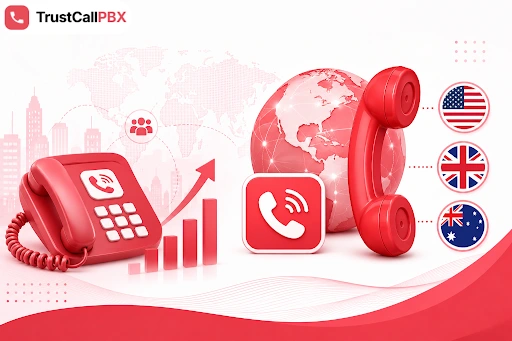
Few things signal “established business” quite as effectively as a toll-free number. When a customer in the US dials an 800 number, or a UK customer calls a 0800 line, there’s an immediate often subconscious perception shift: this isn’t just someone’s personal mobile number, this is a real business with proper infrastructure behind it.
For businesses operating internationally, especially those based outside the country they’re serving, toll-free numbers offer something particularly valuable: a way to project local, professional presence without the cost and complexity of setting up a physical office in that country. Platforms like TrustCall PBX make this kind of global presence possible from a single dashboard, regardless of where your team is actually sitting.
This guide walks through what toll-free numbers actually are, how they work for international businesses, and what you need to know before getting one for your US, UK, or Australian operations.
What Is a Toll-Free Number, Really?
A toll-free number is a phone number that the recipient (the business) pays for, rather than the caller. When a customer dials your toll-free number, they aren’t charged for the call the cost is absorbed by your business instead.
In the US and Canada, toll-free numbers typically use prefixes like 800, 833, 844, 855, 866, 877, and 888. In the UK, the equivalent is the 0800 (and increasingly 0808) number range. In Australia, toll-free numbers typically use the 1800 prefix. You can browse live availability for each of these ranges on the TrustCall PBX numbers page.
For businesses, the appeal isn’t just the “free call” aspect for customers — though that matters it’s also the perception of scale and legitimacy that comes with having a toll-free number as your primary contact line.
Why International Businesses Use Toll-Free Numbers
Projecting Local Credibility Without a Local Office
If your business operates from India but serves customers in the US, having a US toll-free number means American customers see and dial a number that feels native to their market. They don’t need to know or care that your support team might be based in Noida. The toll-free number is the front door, and it looks exactly like the front door of any US-based company. This is the exact use case TrustCall PBX is built around: helping offshore teams sound like a local business in the market they’re serving.
Removing Cost Barriers for Customers
Especially for support lines, sales inquiry lines, or any scenario where you want to encourage customers to call rather than email, removing the cost barrier matters. A customer who might hesitate to call an international number (worried about charges) is far more likely to call a toll-free number, knowing it costs them nothing.
Centralizing Multiple Marketing Channels
Toll-free numbers are also commonly used in marketing campaigns print ads, radio, TV, packaging as a single, memorable contact point that can be tracked separately from other numbers, making it easier to measure which campaigns are driving calls.
Call Routing and Scalability
Behind a single toll-free number, modern cloud telephony platforms allow calls to be routed intelligently to different departments, to an IVR menu (“Press 1 for Sales, Press 2 for Support”), or distributed across a team based on availability. The toll-free number becomes a single point of entry that can scale as your team grows, without customers ever needing to know a different number for each department or employee. See the full set of routing and management tools on the TrustCall PBX features page.
Toll-Free Numbers by Region: What to Know
United States (800, 833, 844, 855, 866, 877, 888)
US toll-free numbers are among the most recognizable in the world, and for good reason they’ve been part of American business culture for decades. For businesses targeting US customers, an 800-series number (or one of its modern equivalents) immediately signals “this is a legitimate US business line.” Availability and activation for these ranges can be checked on the TrustCall PBX USA numbers page.
One thing to be aware of: vanity numbers (toll-free numbers that spell out a memorable word, like 1-800-FLOWERS) are highly sought after and may carry premium pricing or require specific availability. Standard toll-free numbers, however, are generally straightforward to activate.
United Kingdom (0800, 0808)
In the UK, 0800 and 0808 numbers are the standard for toll-free service, and they carry similar weight to US 800 numbers in terms of consumer perception these are numbers people associate with customer service lines, banks, insurance companies, and established retailers. UK-specific ranges, including premium London prefixes, are listed on the TrustCall PBX UK numbers page.
For businesses serving UK customers, having a 0800 number for support or sales inquiries can meaningfully improve the perception of professionalism, particularly for customers who might be wary of calling an international number for things like billing inquiries or support issues.
Australia (1800)
Australian toll-free numbers use the 1800 prefix, and similarly to the US and UK, these numbers are strongly associated with established businesses government agencies, banks, telecom providers, and national retailers commonly use 1800 numbers for their customer service lines. You can explore Australian DID and 1800/1300 availability on the TrustCall PBX Australia numbers page.
For businesses expanding into the Australian market, a 1800 number can help establish credibility quickly, particularly important in a market where customers may be cautious about engaging with businesses that don’t have an obvious local presence.
How Toll-Free Numbers Work with Cloud PBX
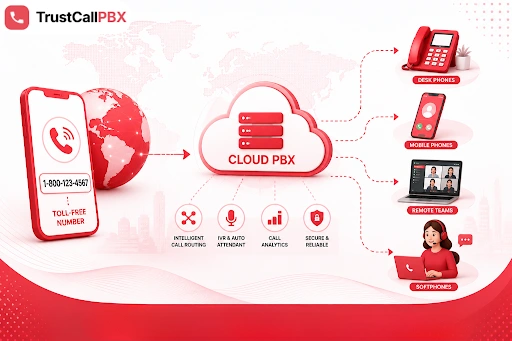
The real power of toll-free numbers comes when they’re integrated into a cloud PBX system, rather than operating as a standalone service. TrustCall PBX is built specifically around this kind of unified setup.
When a customer dials your toll-free number, the call is routed through the telecom network to your cloud PBX provider’s infrastructure, and from there to wherever your team is via SIP softphone apps, mobile apps, or IP desk phones, regardless of physical location.
This means a business can have:
- A US toll-free number for American customers
- A UK 0800 number for British customers
- An Australian 1800 number for Australian customers
all routing into the same unified system, answered by the same team, with calls distinguishable by which number was dialed (so your team knows immediately which market the customer is calling from). A full breakdown of available ranges across these markets is available on the Numbers (DID & Toll-Free) page.
Setting Up Call Flows for Toll-Free Numbers
A toll-free number on its own is just a phone number. Its real value comes from how calls are handled once they arrive. Common setups all supported through TrustCall PBX’s feature set include:
IVR Menus: “Thank you for calling [Business Name]. Press 1 for Sales, Press 2 for Support, Press 3 for Billing.” This routes callers to the right team automatically, reducing wasted time for both the customer and your staff.
Time-Based Routing: Calls during business hours route to live agents; calls outside business hours route to voicemail, an answering service, or an after-hours team in a different time zone (a particular advantage for businesses with teams in India serving customers in the US or UK, where time zone differences can actually become an asset for round-the-clock coverage).
Department-Based Routing: Larger toll-free numbers can route directly to specific departments sales, support, billing each with their own extensions and team members.
Call Queuing: During busy periods, calls can be placed in a queue with hold music and estimated wait times, rather than going straight to a busy signal or voicemail.
Cost Considerations
Toll-free numbers typically involve two cost components: a monthly fee for maintaining the number itself, and a per-minute cost for incoming calls (since the business absorbs the cost the caller would otherwise pay). Current wholesale rates for each region are listed on the TrustCall PBX pricing page.
For businesses evaluating whether a toll-free number makes sense, the key question is usually about call volume and customer expectations. If your business model depends on inbound calls customer support, sales inquiries, bookings the credibility and accessibility benefits of a toll-free number typically outweigh the incremental per-minute costs. If your business operates primarily through outbound calling or digital channels with minimal inbound call volume, a standard local DID number might be more cost-effective.
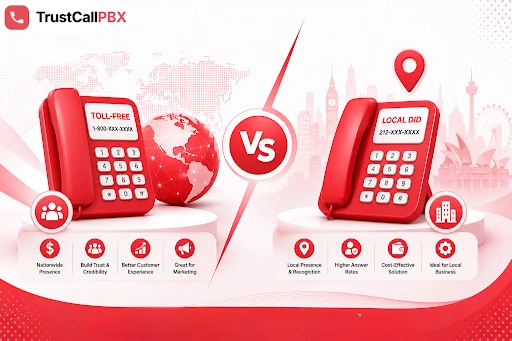
Toll-Free Numbers vs Local DID Numbers: When to Use Which
This is a common point of confusion, so it’s worth being explicit:
Toll-free numbers work best for:
- Primary customer support and inquiry lines
- Marketing campaigns where you want a memorable, trackable number
- Situations where projecting “established enterprise” matters more than “personal local connection”
Local DID numbers work best for:
- Outbound sales and business development calls, where a local area code increases pickup rates
- Account management relationships, where a local number feels more personal
- Markets where you want to test presence without committing to a toll-free setup
Many businesses operating internationally use both: toll-free numbers as the official “front door” for support and inquiries, and local DID numbers for sales teams making outbound calls in specific cities or regions. The full range of both number types, across 150+ countries, is browsable on the TrustCall PBX numbers hub.
Activation and Verification
For major markets like the US, UK, and Australia, toll-free number activation is generally fast often near-instant for standard numbers. However, depending on the provider and the specific number type, some verification (KYC Know Your Customer) may be required, particularly to comply with regulations aimed at preventing fraud and robocalling abuse. Details on what’s required for each region are outlined on the TrustCall PBX compliances page.
It’s worth confirming with your provider what documentation might be needed and how long activation typically takes, especially if you’re planning a launch or campaign around a specific date.
Final Thoughts
A toll-free number is a small line item on your monthly bill that carries an outsized impact on how your business is perceived by customers in the US, UK, or Australia. For businesses serving these markets from elsewhere particularly agencies, SaaS companies, and service providers based in India or other outsourcing hubs toll-free numbers are one of the simplest, most effective ways to close the perception gap between “overseas vendor” and “trusted local business.”
Combined with a proper cloud PBX setup that handles intelligent call routing, IVR menus, and team-wide access regardless of location, a toll-free number stops being just a phone number it becomes the front door to a business that feels exactly as local and professional as any competitor physically based in that market. You can explore the complete set of services on the TrustCall PBX all services page, or get started directly via the pricing and free trial page.