

Real estate has always been a relationship business and relationships are built through communication. But for real estate professionals working with international buyers, investors, or property portfolios spanning multiple cities and countries, traditional phone systems create an awkward gap between the local, trustworthy image a real estate agent needs to project and the reality of operating across borders.
A property investor in Dubai considering a property in London wants to feel like they’re talking to someone with genuine London market knowledge not fielding a call from an unfamiliar international number that might as well be a scam alert. This is precisely the gap that cloud-based VoIP, and specifically local city DID numbers, is built to close.
The Trust Gap in International Real Estate
Real estate transactions, especially international ones, involve significant sums of money and a level of trust that’s hard to establish remotely. Buyers and investors want reassurance that they’re dealing with someone who understands the local market local pricing trends, local regulations, local neighborhoods.
When an agent calls from a number that doesn’t match the property’s location say, calling about a Manhattan apartment from a number with no recognizable US area code it immediately introduces a small but real moment of doubt. Is this really a New York-based agent? Is this legitimate?
A local DID number one with a Manhattan area code, for instance removes that friction entirely. The caller ID itself reinforces the local expertise the agent is trying to convey.
How Local Numbers Work for Real Estate Professionals

Through cloud PBX platforms, real estate agencies and individual agents can obtain DID (Direct Inward Dialing) numbers tied to specific cities — without needing a physical office in that city. These numbers route calls over the internet to wherever the agent is actually working from, via softphone apps on computers or mobile devices.
For an agency that handles properties across multiple cities say, London, New York, and Dubai this means:
- A London number for London property inquiries and follow-ups
- A New York number for Manhattan and broader NYC-area listings
- A Dubai number for Gulf-region clients and properties
Each number can ring through to the same team, or be routed to specific agents who specialize in that market but from the client’s perspective, they’re calling (or being called by) a number that matches the property’s location.
Use Case: Following Up with International Buyers
Consider an agency that’s just listed a high-value property in central London and is following up with a list of prospective international buyers some in the Gulf, some in Asia, some in North America.
If the follow-up calls come from a UK number, recipients are more likely to recognize it as relating to the London property they’ve expressed interest in. A call from an unfamiliar international number, by contrast, is more likely to be ignored and in real estate, a missed follow-up call on a high-value listing can mean a missed opportunity that’s hard to recover.
Use Case: Managing a Portfolio Across Multiple Markets
Real estate investment firms and property management companies often deal with portfolios spanning multiple countries properties in the UK, vacation rentals in Europe, investment properties in the US.
For property managers handling tenant communications, having local numbers for each market means tenants in each location can call a number that feels native to them, rather than an international number that might raise concerns about reachability or cost. Similarly, when the property management company needs to call tenants about maintenance, lease renewals, or other matters calling from a local number significantly increases the likelihood the tenant actually answers.
Use Case: Real Estate Agencies Expanding into New Markets
For agencies looking to expand into a new city or country testing the waters before committing to a physical office a local DID number provides an immediate, low-cost way to establish presence.
An agency based in one country that wants to start generating leads in, say, Toronto, can acquire a Toronto-area DID number, use it for marketing materials and outbound calls to prospective clients in that market, and operate that “Toronto presence” entirely through their existing team without the cost and commitment of opening an actual office until the market has proven itself.
Beyond Voice: Building a Complete Communication Workflow
For real estate professionals, voice calls are just one part of the communication picture, but cloud PBX systems often support a broader workflow:
Call recording: For high-value transactions, having a record of what was discussed and agreed during calls can be valuable both for the agent’s own records and, in some cases, for compliance or dispute resolution purposes.
Voicemail-to-email: Missed calls (which inevitably happen, especially across time zones) can be captured as voicemails and forwarded to email, ensuring no inquiry falls through the cracks even if an agent is unavailable.
Extension-based routing: For agencies with multiple agents specializing in different markets or property types, calls can be routed to the appropriate extension based on the number dialed or IVR selections ensuring inquiries reach someone with relevant expertise.
Mobile flexibility: Real estate is an inherently mobile profession agents are often at property viewings, meetings, or traveling. SIP softphone apps on mobile devices mean agents can make and receive calls on their local business numbers from anywhere, without needing to give out personal mobile numbers.
The Time Zone Advantage
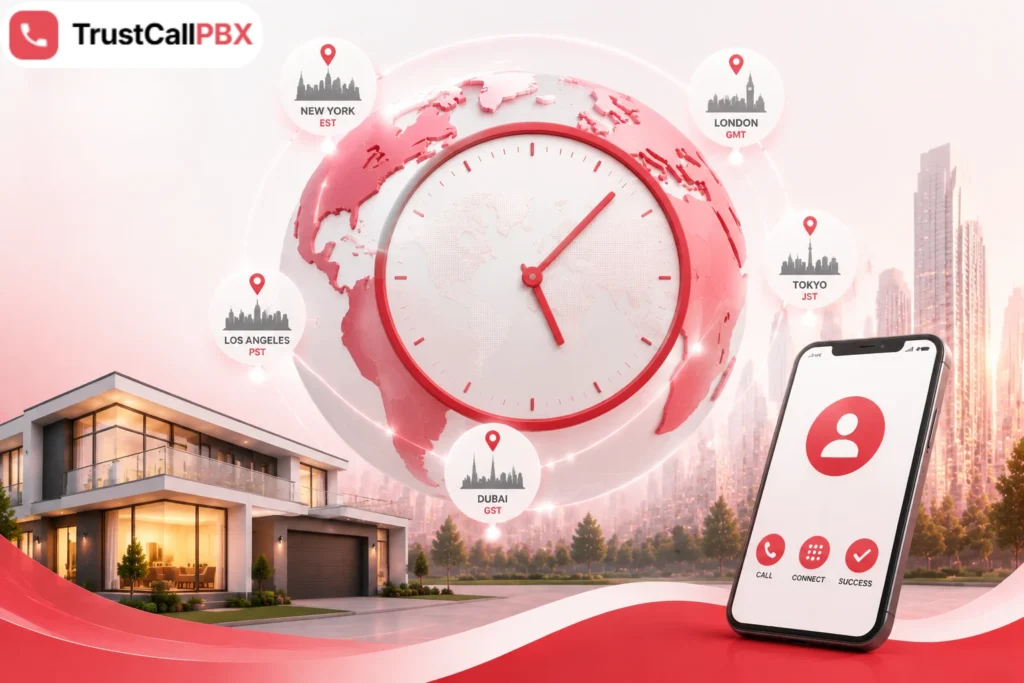
For real estate professionals working with international clients, time zone differences are often seen purely as a challenge but they can also be leveraged as an advantage with the right setup.
An agency with team members across different time zones (or a single team willing to work flexible hours) can offer extended “local hours” coverage for international clients. A UK number, for instance, could be staffed during UK business hours by a UK-based team member and during off-hours by a team member in a different time zone from the client’s perspective, calls to “their” local number are answered promptly regardless of when they call, without needing to know or care about the underlying staffing arrangement.
What to Look for in a VoIP Provider for Real Estate
City-level number availability: Beyond just country-level coverage, check whether the provider can offer numbers tied to specific cities relevant to your target markets London, New York, Dubai, Toronto, Sydney, and so on.
Call quality: Real estate conversations often involve detailed discussions pricing, terms, property specifics where misheard details due to poor call quality could lead to costly misunderstandings. HD audio quality matters significantly here.
Call recording and storage: For agencies that want to maintain records of client conversations, confirm how call recordings are stored, how long they’re retained, and how easily they can be retrieved if needed.
CRM integration potential: While not always a built-in PBX feature, consider whether the platform’s CDR (Call Detail Record) data or APIs could integrate with your existing CRM, allowing call activity to be logged against client/property records automatically.
Reliability for high-stakes calls: A dropped call during a delicate negotiation isn’t just an inconvenience it can affect the outcome of a deal. Look for providers emphasizing carrier-grade reliability and uptime guarantees.
A Note on Compliance
Real estate transactions, particularly international ones, can be subject to various regulatory considerations anti-money laundering (AML) requirements, know-your-customer (KYC) processes, and in some jurisdictions, specific rules about call recording and data handling.
While the VoIP provider itself isn’t responsible for your agency’s regulatory compliance, choosing a provider that operates on properly licensed, compliant infrastructure (rather than informal or grey-market routing) reduces the risk of your communication infrastructure becoming a compliance liability particularly relevant for agencies operating across multiple jurisdictions with different regulatory environments.
The Bigger Picture for Real Estate
International real estate is, at its core, about making distant opportunities feel close and trustworthy. A buyer in Singapore considering a property in Manchester needs to feel like they’re dealing with someone who genuinely understands Manchester its neighborhoods, its market dynamics, its quirks.
Local DID numbers are a small piece of technology, but they directly serve this larger goal. They remove a subtle but real source of friction the moment of “wait, who’s calling me from this strange number?” and replace it with the immediate, almost subconscious reassurance of local familiarity.
For real estate agencies and professionals looking to expand their reach across borders without losing the local trust that drives this business, cloud-based VoIP with city-specific local numbers isn’t a technical curiosity. It’s a direct investment in the trust that closes deals.