

The shift to remote and distributed work has been one of the defining changes in how businesses operate over the past several years and it’s no longer a temporary adjustment. Teams are now routinely spread across cities, countries, and time zones, with businesses hiring talent based on skills and cost-effectiveness rather than proximity to a central office.
But this shift created a problem that often gets overlooked in discussions about remote work tools: what happens to the phone system? If your “office phone” was a physical device sitting on a desk in a central location, how does that work when there’s no longer a single central location or when team members are scattered across multiple countries entirely?
This is where cloud-based VoIP becomes not just useful, but foundational to how distributed teams actually function.
The Problem with “Remote Work” and Traditional Phone Systems
Traditional PBX systems were built around a simple assumption: everyone works from the same physical location, connected to the same physical phone lines. Remote work breaks this assumption entirely.
Businesses that tried to adapt traditional systems to remote work often ended up with awkward workarounds: forwarding office calls to employees’ personal mobile numbers (blurring the line between work and personal communication, and creating privacy concerns when employees leave), or simply accepting that remote employees couldn’t really use the “office phone system” at all and relied entirely on personal devices for work calls.
Neither of these is sustainable for a business that wants professional, consistent communication particularly when client-facing roles (sales, account management, support) are involved.
How Cloud VoIP Solves This
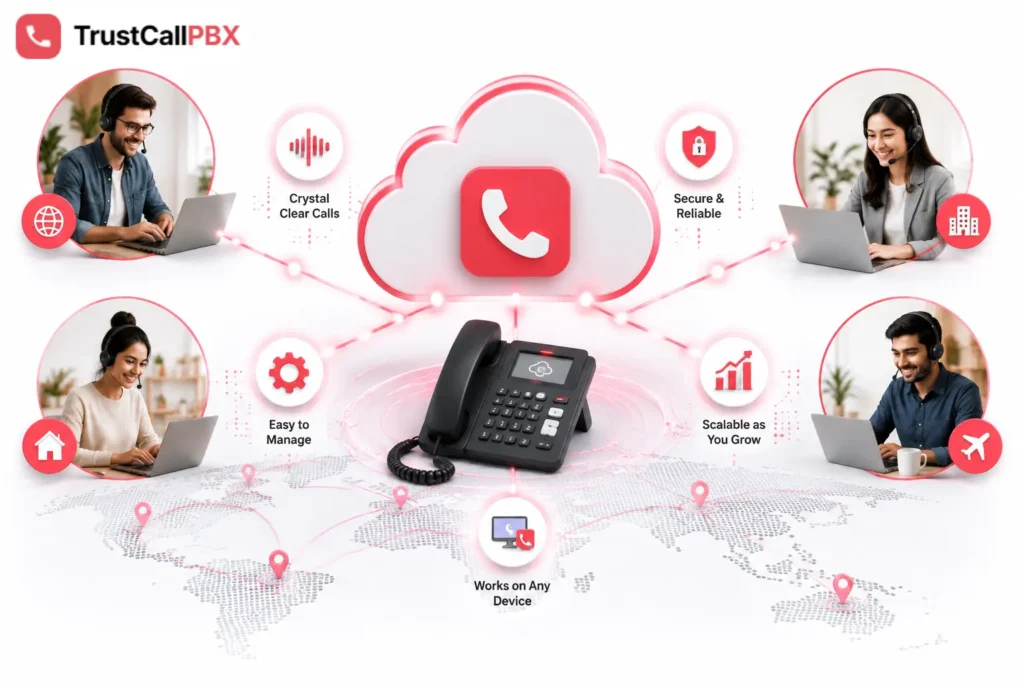
Cloud-based VoIP systems are fundamentally location-independent. Because the entire system extensions, call routing, voicemail, the works exists in the cloud rather than as physical hardware in an office, any team member, anywhere with an internet connection, can access the same system through a softphone app on their computer or mobile device.
This means:
Every team member gets a real business extension, regardless of where they’re physically located whether that’s a home office in Mumbai, a co-working space in London, or a hotel room during business travel.
Calls to the business’s main numbers route to the right person, regardless of that person’s location a customer calling the company’s main support line reaches whoever is configured to handle that call, whether they’re in the office or working from home in a different city.
Team members can make outbound calls using business numbers, not personal numbers meaning a salesperson working from home in Pune can make calls that display the company’s US business number, maintaining the same professional caller ID regardless of where the call physically originates.
Global Hiring Becomes Genuinely Practical
One of the most significant implications of cloud VoIP for distributed teams is how it enables genuinely global hiring not just remote work within a single country, but building teams that span multiple countries entirely.
Consider a business that wants to build a customer support team covering extended hours for US customers. Rather than requiring a single team to work unusual shifts (night shifts in one location to cover US daytime hours), the business could hire team members across different time zones perhaps some in India, some in Eastern Europe, some in Latin America each working normal daytime hours in their own location, but collectively covering an extended support window for US customers.
With cloud VoIP, all of these team members can be part of the same phone system, accessing the same numbers, queues, and call routing the customer calling the support line has no way of knowing (and no reason to care) which country the agent answering their call is located in.
Maintaining Professional Standards Across a Distributed Team
For client-facing roles especially, maintaining consistent professional standards across a distributed team matters clients shouldn’t experience a different “quality” of communication depending on which team member or location they happen to interact with.
Cloud VoIP supports this consistency in several ways:
Standardized caller ID: Whether a sales call comes from a team member in the head office or someone working remotely from another country, the caller ID can consistently show the appropriate business number (and ideally, a local number relevant to the client’s location).
Call recording for quality assurance: Distributed teams can be harder to directly supervise in real-time, but call recording allows managers to review call quality regardless of where team members are located supporting consistent coaching and quality standards.
Unified reporting: CDR data and analytics aggregate across the entire team regardless of location, giving managers visibility into call volumes, durations, and outcomes across the whole distributed operation not just the portion that happens to be in a central office.
The Time Zone Advantage, Properly Leveraged
Distributed teams across time zones are often framed as a challenge to be managed but with the right communication infrastructure, time zone differences become a genuine operational advantage.
Extended coverage without overtime: Rather than asking a single team to work split shifts or overnight hours to cover international business hours, distributed teams across time zones can each work standard daytime hours while collectively providing extended coverage.
Faster response times: For businesses serving clients across multiple time zones, having team members distributed across those zones means client inquiries can often be addressed within that client’s normal business hours, rather than waiting for a centralized team’s working hours.
Continuous operations for time-sensitive work: For operations where work needs to continue around the clock certain types of support, monitoring, or processing tasks distributed teams across time zones provide natural continuity without requiring anyone to work genuinely unsociable hours.
Practical Considerations for Setting Up Distributed Team Communication
Device and Connectivity Standards
While cloud VoIP works on virtually any device with internet access, businesses should consider setting baseline standards for remote team members reliable internet connectivity, quality headsets (poor audio quality reflects on the business regardless of where the call originates), and appropriate quiet working environments for client-facing roles.
Softphone App Consistency
Standardizing on specific softphone apps (such as Zoiper or Linphone) across the distributed team simplifies support and troubleshooting rather than each team member using whatever app they’re personally familiar with, a consistent setup means IT support and onboarding processes can be streamlined.
Extension and Permission Management
As distributed teams grow, managing extensions, permissions (who can access which numbers, who can make international calls, who has access to call recordings), and routing rules through a centralized dashboard becomes increasingly important this is typically straightforward in cloud PBX platforms but benefits from being thought through deliberately as the team scales, rather than configured ad-hoc.
Onboarding and Offboarding
For distributed teams, especially those with higher turnover in certain roles, having a clear, repeatable process for setting up new team members’ phone access (and promptly removing access when someone leaves) matters cloud-based systems make both processes fast (typically just dashboard configuration), but only if the process itself is defined.
Security Considerations for Distributed Access
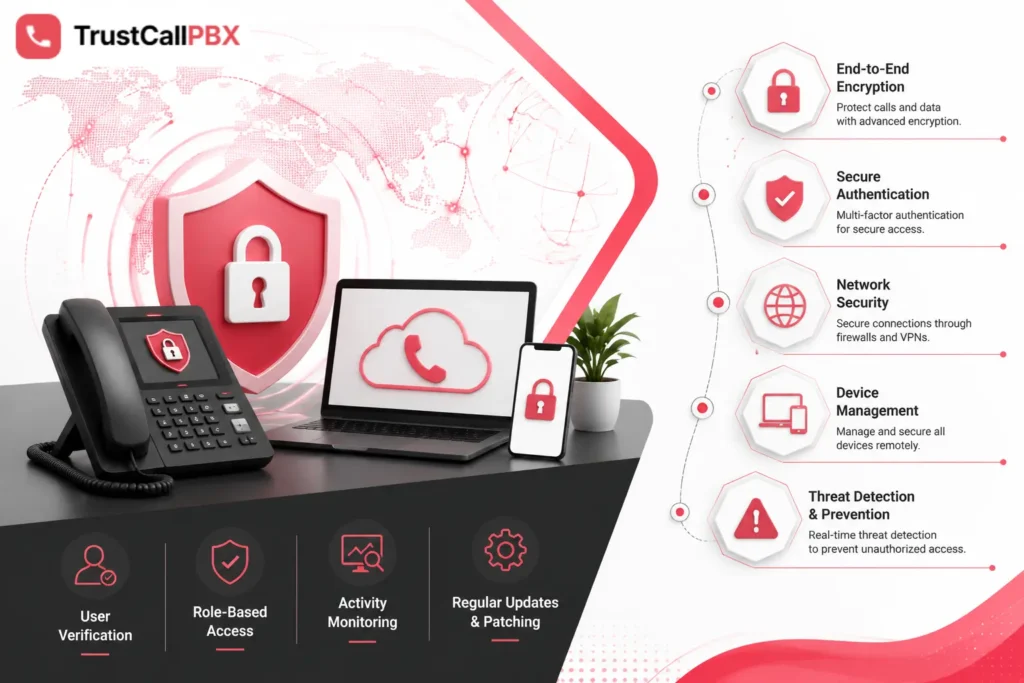
With team members accessing the business phone system from various locations and networks home internet connections, co-working spaces, while traveling security considerations that might be less prominent in a single-office setup become more relevant:
Encrypted connections: TLS/SRTP encryption (covered in more detail elsewhere) ensures that calls remain secure regardless of the network they’re traveling over important when team members might be using less secure networks (public Wi-Fi while traveling, for example).
Access controls: Ensuring that extensions and system access are properly secured (strong credentials, and ideally, limiting access to what each role actually needs) reduces risk in a distributed setup where physical security of a single office location isn’t a relevant control.
The Bigger Shift: Communication Infrastructure as a Talent Strategy Enabler
Perhaps the most significant way to think about cloud VoIP for distributed teams isn’t as a “phone system” at all it’s as part of the infrastructure that makes a particular talent strategy possible.
Businesses that can hire the best person for a role regardless of their location rather than being constrained to local talent pools gain access to broader talent, often at more competitive costs, and can build genuinely follow-the-sun operational coverage. But this strategy only works if the operational infrastructure (including communication) actually supports it seamlessly.
Cloud VoIP removes what would otherwise be a significant operational barrier to distributed hiring the question of “how would this person actually handle business calls from where they’re located?” With cloud VoIP, the answer is simply: the same way anyone else does, through a softphone app and an internet connection, with full access to the business’s numbers, extensions, and call routing, regardless of where in the world they happen to be.
For businesses building or scaling distributed teams in 2026 and beyond, communication infrastructure that assumes everyone works from one location isn’t just outdated it’s actively constraining the talent and operational strategies available to the business. Cloud VoIP removes that constraint, turning “where is this person located” into a non-issue for day-to-day business communication.