
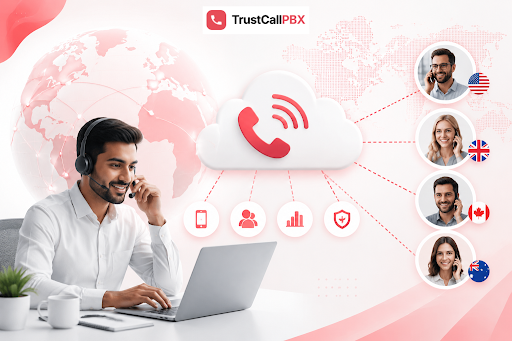
If you run a digital agency in India and most of your clients sit in the US, UK, Canada, Australia, or Europe, you already know the daily struggle. Calls drop. Clients don’t pick up unknown numbers. International calling rates eat into your margins. And every time you try to sound “local” to a client in New York or London, you end up explaining why your number shows up as a long, unfamiliar international code.
This is exactly why a growing number of Indian agencies from small SEO shops to full-service digital marketing firms with 20-30 people are quietly moving their entire calling infrastructure to cloud PBX platforms. Not because it’s trendy, but because the old way of doing business calls simply doesn’t work anymore in a world where clients expect instant, local-feeling communication.
The Old Way Was Broken
Picture this. Your sales executive in Noida picks up the phone to follow up with a prospect in Texas. The prospect’s phone shows an unfamiliar +91 number. Nine times out of ten, that call goes straight to voicemail or worse, gets blocked as spam.
Even when the call does connect, audio quality on traditional international calling plans can be patchy. There’s lag, echo, and sometimes the call drops mid-conversation right when you’re closing a deal. For an agency whose entire business depends on building trust with overseas clients, this is a serious problem.
Then there’s the cost. Traditional telecom operators charge premium rates for international minutes, and those costs add up fast when your sales and account management teams are making dozens of calls a day to the US, UK, and Australia.
What Changed: Enter Cloud PBX
Cloud PBX (Private Branch Exchange) is essentially your entire office phone system, but hosted on the internet instead of physical hardware sitting in a server room. Instead of investing in expensive phone lines, EPABX boxes, and landline connections, your team simply logs into a softphone app on their laptop or mobile and starts making calls using local numbers from the country they’re calling.
For an agency working with international clients, the biggest game-changer is the ability to get local virtual numbers (DIDs) in the same country as your client. A platform like TrustCall PBX, for example, lets you activate numbers across 150+ countries, including the USA, UK, Australia, and Canada all from a single dashboard.
So when your account manager calls a client in London, the client’s phone shows a UK number. When your SEO lead follows up with a prospect in Toronto, it’s a Canadian number on the caller ID. This single change has a measurable impact on whether your calls actually get answered.
Why This Matters So Much for Agency Sales Teams
Agencies live and die by their sales pipeline. If your BDMs (Business Development Managers) and sales executives are spending hours every day trying to get prospects on the phone, and most calls aren’t even being picked up, that’s a massive drain on productivity and revenue.
Local presence calling using a number that matches the prospect’s country and area code has consistently been shown to increase pickup rates dramatically compared to calling from an unfamiliar international number. People are simply more likely to answer what looks like a call from someone in their own city or region.
For an agency that’s cold-calling or following up with leads in the US, UK, or Australia every single day, even a modest improvement in pickup rates can translate into significantly more conversations, more demos booked, and more deals closed without hiring a single additional salesperson.
Cost Control: The Other Half of the Equation
The second reason agencies are making this switch is cost. Traditional international calling plans from local Indian telecom providers are priced for occasional use, not for a sales team making hundreds of outbound calls a day to multiple countries.
Cloud telephony platforms that operate on wholesale, Tier-1 routing arrangements can offer substantially lower per-minute rates for international calls. Instead of paying retail international rates through your mobile carrier, your agency pays wholesale rates directly through the PBX provider.
For an agency with a sales team of even 3-5 people making regular international calls, this difference compounds every single month. Multiply that across a year, and the savings on your telecom bill alone can be substantial money that can instead go toward hiring, marketing, or simply improving your margins.
Compliance and “White Routes” Why It Matters
One thing many agencies don’t think about until it bites them: not all international calling routes are equal. Some cheaper VoIP routes operate through what’s known as “grey routes” unofficial paths that bypass standard carrier interconnect agreements. These routes are often unstable, can suddenly stop working, and in some cases can get your numbers flagged or blocked entirely by international carriers.
This is where it becomes important to work with a provider that explicitly operates on 100% legal white routes meaning your calls travel through proper, carrier-grade interconnects that won’t suddenly get flagged as spam or fraud. For an agency whose reputation and client relationships depend on reliable communication, this isn’t a minor technical detail. It’s the difference between a calling number that works consistently for months and one that gets silently blacklisted after a few weeks.
Beyond Voice: Building a Full Communication Stack

Cloud PBX isn’t just about making outbound sales calls. For agencies serving international clients, it becomes the backbone of an entire communication workflow:
- Inbound support lines: Clients can reach your account managers or support team through a local number in their own country, making your agency feel like a local presence even though your team operates from Noida or Gurugram.
- Toll-free numbers: For agencies that want to project a more established, enterprise-grade image, toll-free numbers in the US, UK, or Australia add a layer of credibility that a standard mobile number simply can’t.
- Call recording and analytics: Most cloud PBX platforms include call recording, which is invaluable for sales training, quality assurance, and resolving any disputes about what was promised to a client.
- Extension management: Each team member sales, support, account management gets their own extension, so calls can be routed intelligently without anyone needing a separate physical phone line.
- Mobile flexibility: Because it’s all software-based, your team can take calls from anywhere using SIP softphone apps like Zoiper or Linphone, whether they’re in the office or working remotely.
Real-World Impact for a Growing Agency
Consider an agency with a sales team handling outreach to clients across the US, UK, and Australia, plus an account management team that needs to stay in regular contact with existing clients across those same regions.
Before switching to cloud PBX, this agency might be juggling multiple SIM cards, international roaming packs, and unreliable call quality all while paying premium rates and struggling with low pickup rates on cold outreach.
After switching, the same agency can operate local numbers in each target country, route calls intelligently to the right department or person, record calls for training purposes, and pay wholesale rates for international minutes. The sales team starts having more conversations because more calls get answered. The account management team builds stronger client relationships because clients feel like they’re talking to a local representative. And the finance team sees a noticeable reduction in the monthly telecom spend.
What to Look for When Choosing a Provider
If you’re an agency owner considering this switch, here are the things that actually matter:
- Number availability in your target markets — Make sure the provider can issue numbers (DIDs) in the specific countries your clients are based in, with reasonably fast activation, especially for high-demand markets like the USA, UK, Australia, and Canada.
- Call quality and network reliability — Look for providers that mention HD voice codecs (like G.711), low-latency routing, and carrier-grade interconnects with high uptime guarantees.
- White-route compliance — Confirm the provider uses legitimate, carrier-approved routes rather than cheap grey routes that risk getting your numbers blocked.
- Wholesale pricing transparency — Understand exactly how per-minute rates are calculated for the countries you’ll be calling most.
- SIP softphone compatibility — Your team should be able to use familiar apps like Zoiper or Linphone on both desktop and mobile.
- Support responsiveness — When something goes wrong with a client call mid-deal, you need a support team that responds quickly, ideally with 24/7 availability.
The Bigger Picture
For Indian agencies, the shift to cloud PBX isn’t really about telephony as a standalone expense it’s about removing friction from the client relationship. Every dropped call, every unanswered cold call, every moment a client feels like they’re dealing with an “overseas” vendor instead of a trusted local partner chips away at the relationship.
By investing in a proper cloud telephony setup with local numbers, reliable white routes, and wholesale international rates, agencies are essentially buying themselves a more professional, more trustworthy front door to every conversation with their international clients while simultaneously cutting their monthly communication costs.
For an industry built on trust, responsiveness, and the ability to “feel” like a local team even when you’re operating from thousands of kilometers away, that combination is hard to ignore. It’s not surprising that this is quickly becoming a standard part of how serious Indian agencies operate, rather than an optional upgrade.